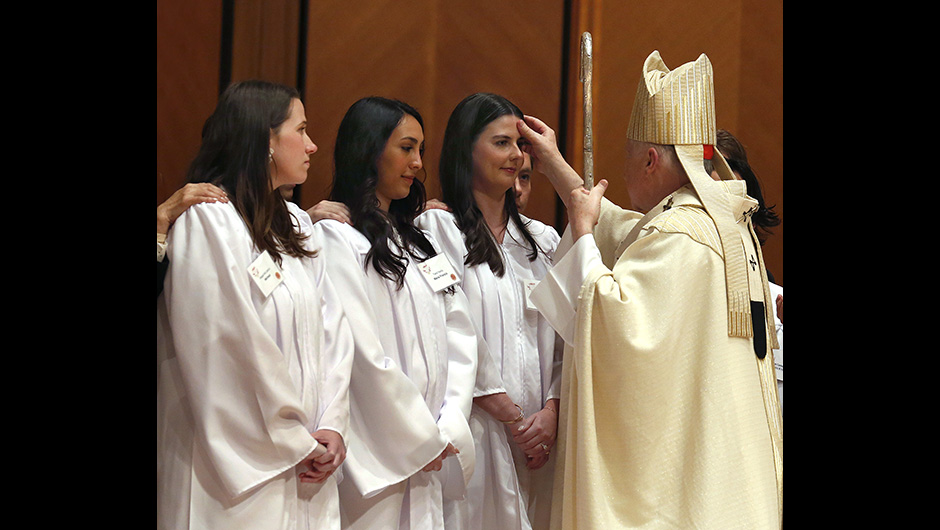
A survey of more than 2,100 people across 20 dioceses and archdioceses who came into full communion with the Catholic Church this year found that many of them are looking to satisfy a personal hunger for truth or goodness, and that many are attracted to the stability and wisdom the institutional church.
The survey also found that, contrary to a media narrative that more young men are showing interest in Catholicism, those coming into the church were fairly evenly split, with 54 percent of respondents being women.
“It’s a much more balanced picture,” said Tim Weiske, director of the Department of Parish Vitality and Mission. “That was the biggest surprise.”
The survey, “Why Are So Many People Becoming Catholic: 20 U.S. Catholic Dioceses Collaborate to Study Emerging Interest in the Catholic Church,” started in the Archdiocese of Chicago when it became clear that the number of people receiving sacraments of initiation at the Easter Vigil would be about 50% higher than last year, Weiske said.
The survey was designed to find out what was motivating people to want to learn more about the church and participate in the Order of Christian Initiation for Adults, as well as what barriers and what encouragement they found along the way, Weiske said.
When archdiocesan staff mentioned it to counterparts in other dioceses, some showed interest in doing the same. Eventually, the survey included information from 20 dioceses across the United States, from St. Petersburg, Florida, to Seattle.
The main differences researchers noted between dioceses had to do with previous religious experience: In regions that historically have large Catholic populations, respondents were more likely to have been baptized Catholic and stopped practicing at some point; in regions that historically have smaller Catholic populations, respondents were more likely to have participated in other churches.
Across the United States, those who became Catholic or completed their sacraments of initiation most often said they were looking for a deeper spirituality or relationship with God and that they wanted to grow in goodness and virtue, to more deeply understand truth and to cultivate a sense of inner peace, according to the survey results.
The next most common motivations included attraction to Catholic liturgy, prayer and ritual and attraction to the church’s longevity and the wisdom it has developed over two millennia, as well as hope for finding joy and life’s ultimate purpose.
The third tier of motivations included a desire for healing or redemption from personal challenges and finding a sense of belonging.
“Everyone has their own story. We recognize that,” Weiske said. “This gives a sense of proportion. There is a group that is looking for that stability, that grounding, compared to the shifting sands of our constantly changing society.”
Pat Brown, strategy and research manager for the archdiocese, said he was surprised that finding healing and belonging were cited by only a little more than half the respondents, fewer than the number of respondents who named a personal hunger for truth and goodness or an attraction to features of the institutional church as their main motivations.
Given public attention to mental health challenges among young adults and wider surveys that show spiritual seekers, Brown said, researchers expected more respondents to name belonging and healing as motivations.
“That was a disconnect between the general public and respondents,” Brown said.
For Weiske, that offers an opportunity to respond more effectively to people who are seeking healing and belonging.
Overall, Weiske said, the survey “affirms what we’ve been emphasizing with our spiritual renewal, approaching people where they are, asking questions, listening, accompanying each person to that next step the person is ready for.”
The survey also showed that fear was a barrier for about a quarter of respondents: fear of being negatively judged by friends or family, of not feeling accepted by the community, of not being spiritually prepared.
“If you’re new in any social situation, it’s always a little uncomfortable,” Weiske said. “Is the church any different? What is specific to us is that we have a particular ritual, and if you’re unfamiliar with it, or if you haven’t practiced regularly in a long time, it can be confusing.”
That should serve as a call for everyone in parishes, from clergy to parishioners in the pew, to “put on the mind of someone new,” Weiske said, for everything from giving directions to where coffee and doughnuts are being served after Mass to giving better cues in the worship aid for what to do during the Mass.
Most respondents did not have a negative opinion of the Catholic Church when they started inquiring about OCIA. They were either indifferent or didn’t have enough knowledge to form an opinion.
Weiske said that fits with recent observations that many young adults who were baptized Catholic never actively made a decision to leave the church. For many of them, their families did not practice the faith regularly and at some point they fell out of the habit of participating.
The respondents of all generations also had a higher level of education than the general population, which tracks with what the Archdiocese of Chicago has seen with rising Mass attendance at parishes in neighborhoods with lots of college-educated young adults.