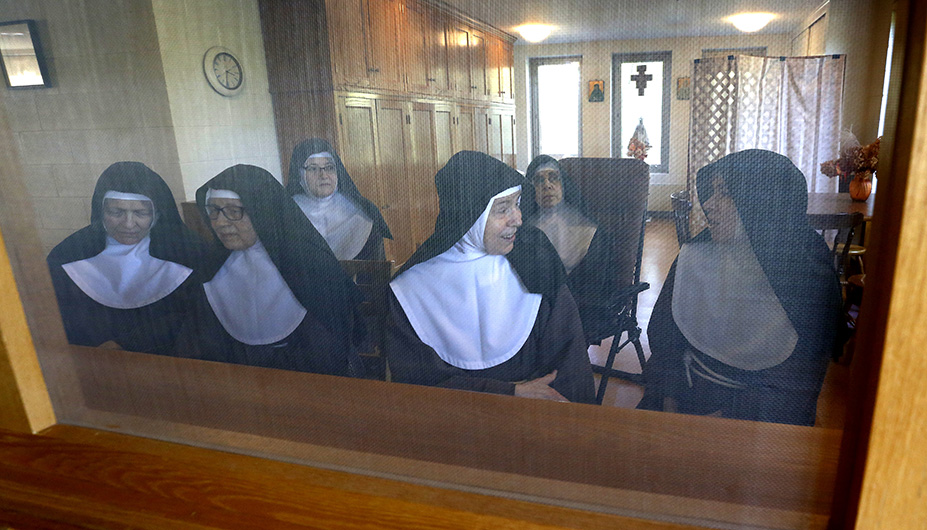
For 25 years, a small group of Poor Clare sisters has lived a quiet and enclosed existence in Immaculate Conception Monastery in Palos Park.
But in the Jubilee Year of St. Francis, the community is putting out the welcome mat and inviting women to discern a vocation to their way of life.
Today, six women live a life of simple poverty, dedicated to prayer and penance, in the enclosed world inside the Southwest suburban monastery. They follow the rule of their founder, St. Clare — a young woman from Assisi, Italy, who left her wealthy family in 1212 to begin a community of religious women under the guidance of St. Francis.
Each Poor Clare monastery is independent and there are believed to be more than 20,000 Poor Clares, also known as the Poor Ladies, living lives of prayer in more than 70 countries. The women take vows of poverty, chastity, obedience and enclosure, living in a cloister and shutting themselves off from the rest of the world to pray and work.
The sisters recently spoke with Chicago Catholic editor Joyce Duriga during a visit to their monastery. The sisters can meet with guests through a screen partition in their parlor during designated times. This is what they shared about living a radical life of prayer in today’s world.
Chicago Catholic: You all live a very different life from what the average woman experiences today.
Mother Paul Marie: It’s like a hidden life. We’re not in the spotlight, but we’re called to be hidden with Christ and God.
Our monastery is like the city set on the mountaintop. People don’t know us, but they know the monastery’s there and they know it’s for them. They know it’s for the church. They know it’s for the world.
You could say we really are daughters of St. Francis for the radicality. Now, we don’t have the life of the friars. We don’t go out. We’re not missionaries in that sense. But we are especially called to give ourselves that radically to Christ. We leave behind everything that’s near and dear.
Chicago Catholic: One of the things you leave behind is your families. But you do exchange letters and they can come and visit you in the parlor during visiting hours.
Sister Miriam: We have one sister in another monastery, but she’s in the middle of eight children. She has seven siblings, and she’s in the middle. But she said that her father said, “You are the center of the family.” It’s because of her vocation.
None of us are at family gatherings, but we’re so present. We feel so close to them because we’re praying for them. And we’re so united, whatever it may be, a wedding or a family reunion or whatever. We’re not missing out, really. Physically, yes, but the spiritual bond is so much deeper because you can be in the same room physically with someone and be worlds apart.
Chicago Catholic: Is it a difficult transition to this life?
Sister Colette, who joined in 2002: For me, there was the peace of knowing you’re doing God’s will, but also the peace of the life itself.
I was working and paying off my student loans and things like that, and you have to take care of everything yourself, your job, your food, your rent, all those things you have to worry about. You leave that behind. You take on new responsibilities, and it’s a new experience, but there’s just such a peace.
Mother Paul Marie: It’s a leap of faith. You don’t know what you’re going to because it’s really an enclosed life, this enclosure. You have never been there. You’re going to enter into, first of all, a monastery, a building that you are not familiar with, then a whole family, a new family.
It’s really a leap of faith. You need to overcome yourself and say, “Yes, it’s the Lord who’s calling me.” I think this is something that everyone will feel, especially in contemplative vocations. As soon as you have answered, you can feel, yes, this is it. Although it’s all strange and completely new.
Chicago Catholic: It’s a process too, you said. If a woman feels God is calling her to enter the cloister, she doesn’t just walk in the next day.
Mother Paul Marie: There are stages to help us to further discern, to get used to the life, but also to get to know the life, to become accustomed to it, to be able to enter into it.
The first stage is called the aspirancy. A young woman, she comes in contact with the monastery and she gets to know us, first of all. She comes to visit, comes to a decision and applies to enter.
As an aspirant, she would spend at least six months outside the enclosure, but getting closer to the community, learning more about it, getting to know the life better, getting to know herself and whether she would have the capacity to live this vocation.
Then she enters the enclosure, and she’s an aspirant for at least six more months inside before she becomes a postulant. She then spends two years as a novice then takes temporary vows. All this time, she’s discerning and there is a growing clarity whether or not this life is for her.
It’s a long period of formation, but it’s formation to live it for a lifetime. But if it looks like they’re not called to the life, they have the freedom to say, “You know, this is not my way,” and they can go. That’s the whole purpose of discernment, to do God’s will. In his will alone is our peace, our happiness, our real fulfillment.
Chicago Catholic: Do you think a cloistered vocation is as relevant today as it was 800 years ago, when Francis and Clare started the first convent?
Mother Teresita: This is a ministry, so to speak, a ministry of prayer, sacrifice and witness that is always needed in the church, always necessary. Many congregations often arose because of one or the other necessity, and then if that need faded, those congregations would die out.
But the church always needs people who take the world in their hearts and lift them up to God. That is always necessary, always needed. That’s why I’m sure that the Poor Clares and the Carmelites, they will exist until the end of time. Because it’s necessary for the church.
Sister Miriam: One of our priests said we are like the power plant of the church. Not because I’m Sister So-and-So, but because of the vocation.
Not that active sisters do not have a role. They surely do. Our active sisters are so dedicated. But we’re just here. We have our prayer schedule, and we don’t have a lot of distractions. We’re just here for God and he uses it for his purposes.
Mother Paul Marie: It’s a union with Christ. We are united with Christ through our vows so that there is a special power. Not because of us, but because of Jesus and his merits. The union with Jesus, that makes it powerful. It’s not because I have so many capacities and so many talents. The union with Jesus, that makes it powerful. That is essential.
The following questions were asked later:
Chicago Catholic: Part of the radicality of a Poor Clare’s life is not wearing shoes and sleeping on hard beds. That can be hard for those of us on the outside to understand. Francis and Clare both abandoned their shoes as a sign of giving everything to the Lord and traveling light as the apostles were called to do. There is a point to sleeping on straw mattresses too.
Mother Paul Marie: Going unshod also reminds us of reverence, as in the story of Moses and the burning bush: “Put off the sandals from your feet, for the place where you stand is holy ground.” It also speaks of poverty, of penitence — penitents went barefoot and were clothed in sackcloth — of lowliness of heart.
Inside the monastery we always go unshod, unless a sister would have an infirmity and the abbess would give her permission to wear cloth sandals, or shoes if she needed them.
St. Clare also gave permission to sisters going outside the monastery to wear sandals or shoes. We wear lightweight shoes to do garden work, to protect our feet. When walking on cold cement floors in the basement we wear rubber thongs. Along with the spiritual aspects there is a lot of common sense in these practices.
The point St. Clare has in mind for our straw mattresses is poverty, simplicity and penance. To have a hard bed, whatever it is made of, is a penance, as St. Colette notes. We are, after all, an “order of penance,” and happy penitents at that.
But a “hard bed” is not a very terrifying penance, or glamorous, is it? Yet it is real. And at times that can be very helpful — who wants to lounge in a hard bed after the rising bell has rung? It can be a great help for rising promptly to go and sing the Lord’s praises.
And, if the nuns can get good straw (not chaff), it serves well enough as a mattress. In Roswell [New Mexico, where some of the sisters who came to Chicago lived before], we had a frame for packing the straw firmly — very firmly! — inside the straw sack ticking. We still have most of those straw sacks that went ahead of us in the moving van from Roswell to the new foundation in Chicago.
On the other hand, some sisters have a substitute pad of foam (even the straw mattresses should have some “give”) because of a personal need such as an allergy or infirmity. In the holy rule, the sick sisters are permitted to have regular mattresses and feather pillows if needed. You could say that necessity is the golden rule for St. Clare in caring for her sisters.
Chicago Catholic: The convent becomes a family. How do you handle the squabbles or irritations that happen in any family?
Mother Paul Marie: Oh, yes, fallen human nature! The beauty of family life, including a religious family, is that grace and patience can make misunderstandings and differences into occasions of real conversion in our relationships.
When I asked the sisters about this question, they were all smiling: one responded, “We can say, ‘I humbly confess my fault!’” (That’s our monastic expression when we ask pardon for a failing.) Also, “may God reward you” to express gratitude; so often we can forget to be grateful, when gratitude creates bonds of love.
Another said, “Pope Francis told families three ‘words’ are needed for happy family life: ‘May I,’ ‘Thank you’ and ‘I am sorry.’” Our training as young sisters has gone a long way toward holiness and happy community life if we have learned all this!
I would like to add that a smiling silence (not gloomy or reproachful) does wonders for keeping us attentive to God and the things that really matter in life, even when there is a roomful of sisters working together.
On Sundays from noon to 3 p.m. young women ages 18-35 are invited to visit the Poor Clare Monastery of the Immaculate Conception, 12210 Will Cook Road, Palos Park, for adoration to discern their vocation with Jesus. Those interested in the Poor Clares cloistered, contemplative way of life are encouraged to ring the doorbell to speak with the portress or request to speak with the mother abbess. For more information, visit chicagopoorclares.org.