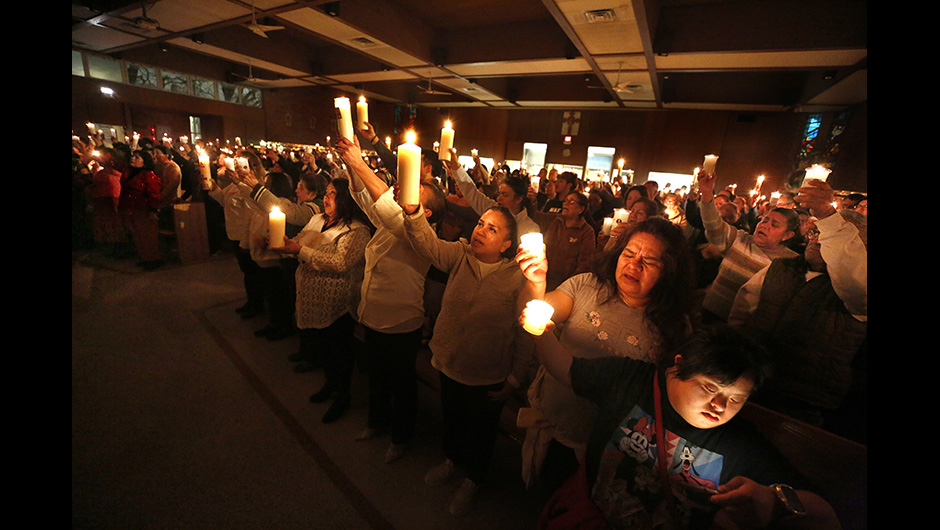
The Archdiocese of Chicago’s new Hispanic Ministry Commission (Comisión Hispana de la Arquidiócesis de Chicago), brings together leaders from different ministries in the archdiocese to help focus on the needs and the gifts of Hispanic Catholics in a spirit of listening and synodality.
“The Hispanic Ministry Commission exists to listen and to accompany and support the Latino communities throughout the archdiocese,” said Luis Beteta Escalante, director of vicariate renewal for Vicariate III. “The role is to make sure that the gifts, the experiences, the challenges, the concerns, the hopes of the community are heard and to shape the responses within the archdiocese.”
Beteta Escalante is one of 21 members of the commission, drawn from different offices within the archdiocese, working with Auxiliary Bishop José María García-Maldonado. Because the members come from different offices and have different areas of expertise and responsibility, they can make the group as a whole aware of different issues and work collaboratively to develop responses, he said.
“We get together to coordinate efforts, to avoid duplication,” Beteta Escalante said. “We can respond together to the needs of the community, look for opportunities to work together and have points of collaboration with each community and each parish.”
The model echoes the wider church’s move toward synodality, said Beteta Escalante.
“There is a clear need to move away from working in silos,” he said. “There is an opportunity to be present as members of the archdiocese, and as members of the Latino community at large. We listen to the needs of the community and reflect together.”
The commission has already surveyed leaders in the archdiocese about what they perceive as the opportunities and needs in the Hispanic community, and is planning a wider survey that will include parish leaders, Catholics who practice their faith regularly and those who participate in their parishes sporadically, if at all, said commission member Ellie Maxwell, the “Explore” operations manager for the archdiocese.
The goal of both surveys is “to listen to understand the issues, hopes and needs of our community, so we can respond to what they are telling us,” Maxwell said. The surveys focus on the four pillars of formation: spiritual, human, pastoral and intellectual.
From the results of the first survey, given to leaders in the archdiocese, “the one that was most needed was human — intercultural competency, diversity among the people themselves,” Maxwell said.
Commission member Belén Morales, senior coordinator of immigration ministry for the archdiocese, said the ultimate goal is the full integration of the Hispanic community in the archdiocese.
“We are gathering with our gifts, we are gathering with our knowledge and experiences, with people from the archdiocese, because we understand it is our responsibility to make sure we are included, we are heard,” Morales said.
Part of that is understanding and sharing that there are many facets of the Hispanic community, and that a diverse community has different needs. That means, for example, that the needs of recent immigrants are different from the needs of children of immigrants who grew up in the archdiocese.
“We hear different needs, we see different needs,” Morales said. “One of the things I like the most are the synodal listening sessions.”
Those sessions, which will be held in each vicariate, are similar to those that happened in the lead-up to the V Encuentro, a national effort to understand the challenges and gifts of Hispanic ministry that culminated with a gathering in 2019, Morales said.
“Coming from V Encuentro, we realized that back then, there were some needs, now there are other needs,” she said. “With everything that has happened — we had COVID, we had Midway Blitz — we have different needs now. We have to listen to each other again. But we don’t want to listen and create ideas and leave them there.”
“Our hope is to have an impact on the formation of lay and ordained leaders,” Beteta Escalante said. “Given the special attention to families, to young people, to migrants, to those who are most vulnerable, the hope is not to just maintain Hispanic ministry, but to help it grow and thrive.”