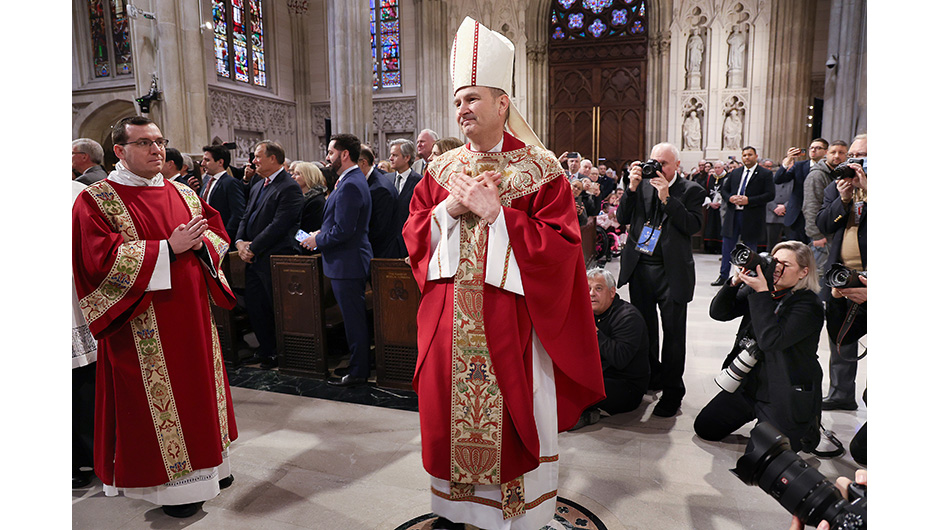
New York Archbishop Ronald Hicks was installed Feb. 6, telling the congregation that filled St. Patrick’s Cathedral that the church must be a “missionary church, a church that catechizes, evangelizes and puts our faith into action, a church made up of missionary disciples who go out and make disciples.”
“This is a call to be a missionary church, not a country club,” Archbishop Hicks said in his homily, preached on a text that included the “great commission” in Matthew 28. “A club exists to serve its members. The church exists, on the other hand, to go out and serve all people on fire with faith, with hope and charity in the name of Jesus Christ.”
Archbishop Hicks, 58, was raised in suburban South Holland and ordained a priest of the Archdiocese of Chicago in 1994. He was named vicar general of the Archdiocese of Chicago in 2015 by Cardinal Cupich, became an auxiliary bishop of Chicago in 2018, and bishop of the neighboring Diocese of Joliet in 2020.
He succeeds Cardinal Timothy Dolan, 76, who has led the Archdiocese of New York since 2009. The archdiocese includes Manhattan, the Bronx and Staten Island and seven counties north of New York City, and has about 2.5 million Catholics.
The installation Mass started with the new archbishop knocking on the iconic Fifth Avenue doors of the cathedral with a small hammer. He was welcomed inside to great fanfare by Cardinal Dolan.
Cardinal Christophe Pierre, apostolic nuncio to the United States, welcomed Archbishop Hicks before reading an English translation of the mandate naming him ordinary of the Diocese of New York signed by Pope Leo XIV on Dec. 18, 2025.
Cardinal Pierre also led the congregation in singing “Happy Birthday” to Cardinal Dolan.
Archbishop Hicks spent a year in Mexico before starting major seminary at the University of St. Mary of the Lake/Mundelein Seminary, working with orphans cared for by the nonprofit Nuestros Pequeños Hermanos. After ordination, he spent five years leading the organization’s operations in Central America from El Salvador.
Several songs and prayers in the liturgy were offered in Spanish, and the first reading was read in Spanish by Samuel Jiménez Coreas, a Salvadoran lay Catholic who endured much hardship and suffering before being cared for at an Nuestros Pequeños Hermanos in El Salvador. He now lives in the United States.
Archbishop Hicks began his homily in Spanish, quoting the lyrics of the song “Alma Missionera,” which calls on everyone to have a “missionary soul.”
When he switched to English, he said “Chicago will always be my kind of town” before offering a tour of lyrics from iconic songs about New York, ending with, “So start spreading the news. I’m starting today. I want to be a part of it: New York, New York.”
Then he turned to telling the congregation things that he expected many of them already knew about him:
“I love Jesus,” he said. “I love the church. I love people. And as Pope Leo has recently taught in his catechesis on Vatican II, Jesus says, ‘I call you friends.’ Through that relationship, I strive to love my neighbor as myself. I also love the Eucharist, the true body, blood, soul, and divinity of our Lord and Savior, Jesus Christ, our source and our summit. The word ‘Eucharist’ comes from a Greek word meaning ‘to give thanks.’ So today, in the context of this Eucharist, my heart is filled with gratitude.”
He thanked Pope Leo; Cardinals Pierre, Cupich and Dolan; and everyone else present, including bishops, priests, civic and religious leaders from other traditions and those who traveled from Illinois.
He also thanked his parents, who could not make the trip.
“To my mom and dad, watching via livestream, you are the best.” Archbishop Hicks said. “Thank you for always showing me what unconditional love looks like.”
Then he turned to Jesus’ commission from the end of Matthew’s Gospel: “Go and make disciples. Baptize them in the name of the Father and of the Son and of the Holy Spirit, and behold, God is with us always. God is with us always.”
His contrast between a club that serves its members and a church, was “not a criticism,” the archbishop said.
“It’s simply an invitation to constantly renew who we are and to rediscover why the church exists,” he continued. “We exist to follow Jesus. We fed the hungry, healed those ill in body and spirit, rejected hatred, and proclaimed love. Pope Leo XIV has been clear and consistent about this. He reminds us that the church is missionary, not because of a program we run, but because of who we are. The church exists to proclaim Jesus Christ and the Gospel to everyone, publicly and credibly, without fear, in every culture and circumstance, a church that upholds human dignity in every way possible, a church that follows the example of Jesus, who reached out beyond his own community and held up the Samaritan as an example of goodness. That is the kind of church I believe we are called to be here in the Archdiocese of New York.”